
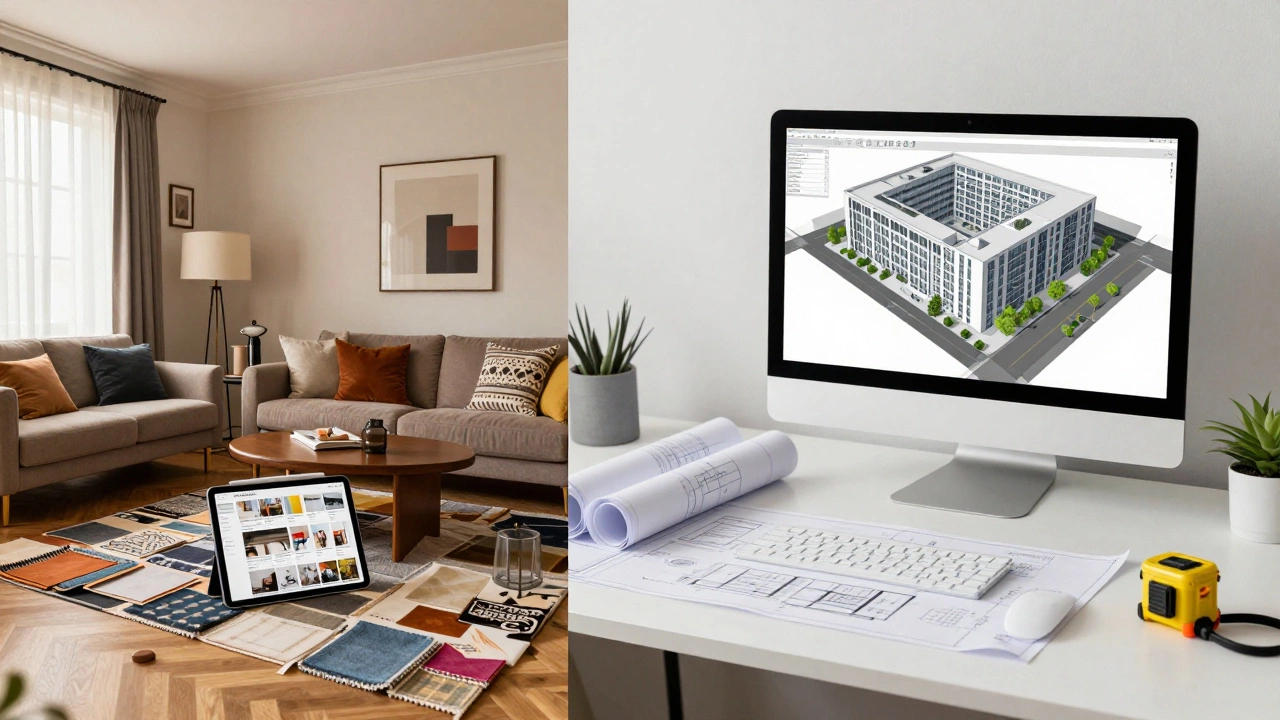
Interior Design Career ROI Calculator
Compare the long-term financial outlook of pursuing an accredited degree versus the self-taught route.
Accredited Degree
High upfront cost, higher earning ceiling, commercial eligibility.
- ✓ Eligible for NCIDQ
- ✓ Commercial/Contract Work
- ✓ Firm Employment
Self-Taught / Certificate
Low upfront cost, limited scope, residential focus.
- ✗ Ineligible for NCIDQ
- ⚠ Residential Only (Usually)
- ⚠ Freelance/Social Media
Adjust Variables
Projected Outcome
$0
Cumulative gross income$0
Earnings minus education costScrolling through Instagram or Pinterest can make you think that anyone with a good eye and an iPad can become a successful interior designer. You see stunning rooms, perfect color palettes, and seamless layouts, and it looks easy. But here is the hard truth: there is a massive difference between decorating your own home and designing spaces for clients who expect technical precision, safety compliance, and functional engineering.
If you are asking whether going to school for interior design is worth the time and money, you are not alone. The industry has changed significantly in recent years. With the rise of AI tools and online courses, the barrier to entry feels lower than ever. However, the professional ceiling remains high without formal education. Let’s break down the real value of a degree versus self-teaching, looking at accreditation, career paths, and the actual return on investment in today’s market.
The Difference Between Decorating and Designing
Before deciding if school is necessary, you need to understand what you are actually studying. Many people confuse interior decoration with interior design. Decoration is about aesthetics-choosing fabrics, colors, and furniture arrangements. It is surface-level styling. Design, on the other hand, involves spatial planning, building codes, ergonomics, lighting calculations, and material specifications.
When you go to school, you aren’t just learning how to pick pretty pillows. You are learning how to read architectural blueprints, understand load-bearing walls, and ensure that a commercial space meets fire safety regulations. For residential projects, this knowledge prevents costly mistakes. For commercial projects like restaurants, offices, or hotels, it is legally required. If you want to work in contract design (commercial), a formal education is practically non-negotiable because clients and architects will not trust an uncredentialed designer with complex builds.
Why Accreditation Matters More Than Ever
Not all degrees are created equal. In the United States and many other countries, accreditation is the golden ticket. Programs accredited by bodies like the Council for Interior Design Accreditation (CIDA) meet rigorous standards set by the industry. Why does this matter? Because most states require licensure or registration to practice as an interior designer, and these boards often require graduation from an accredited program to sit for the National Council for Interior Design Qualification (NCIDQ) exam.
Without NCIDQ certification, your career options are limited. You might be able to start a small residential decor business, but you won’t be hired by large architecture firms, developers, or corporate clients. They need someone who carries insurance and holds credentials that prove they know the law. If you attend a non-accredited program, you may find yourself taking extra general education classes later just to qualify for the exam, which defeats the purpose of saving time upfront.
The Financial Reality: Cost vs. Earning Potential
Let’s talk numbers. A four-year bachelor’s degree in interior design can cost anywhere from $30,000 to over $150,000 depending on whether you choose a public university, a private college, or an art institute. This is a significant investment. Is it worth it? It depends on your career goals.
According to labor statistics, the median annual wage for interior designers is around $64,000, but top earners in commercial design make well over $100,000. Entry-level positions often pay less, starting between $40,000 and $50,000. If you self-teach, you might avoid tuition costs, but you also miss out on the internship networks and portfolio development that schools provide. Graduates from reputable programs often land jobs faster because firms trust their foundational skills. Self-taught designers frequently struggle to get that first foot in the door without a proven track record or mentorship.

What You Actually Learn in School
A typical interior design curriculum covers far more than software. Here is what you can expect:
- Spatial Planning & Ergonomics: Learning how people move through a space and how to arrange furniture for optimal function.
- Building Systems: Understanding HVAC, electrical, and plumbing layouts so you don’t design a wall where a duct needs to go.
- Materials & Finishes: Knowing which materials are durable, sustainable, and appropriate for different environments.
- Digital Tools: Mastering AutoCAD, Revit, SketchUp, and Adobe Creative Suite. These are industry standards, not just nice-to-haves.
- History & Theory: Understanding design movements helps you create timeless spaces rather than chasing fleeting trends.
This structured learning accelerates your growth. Trying to learn Revit or code compliance on your own while working a job is incredibly difficult. School provides a safe environment to make mistakes before you are responsible for a client’s budget and timeline.
The Rise of Alternative Paths
Does everyone need a four-year degree? No. There are alternative paths that might suit you better. Associate degrees (two-year programs) offer a quicker entry into the field, focusing heavily on technical skills. Some community colleges offer CIDA-accredited associate degrees, which can be a cost-effective way to start. You can then transfer credits or gain experience and complete a bachelor’s later if needed.
Additionally, short-term certificates and bootcamps exist. These are great for upskilling if you already have a background in architecture, construction, or even marketing. However, they rarely lead directly to licensure. If your goal is to open your own firm and handle full-service design-build projects, these shortcuts may limit your long-term potential.

Networking and Mentorship: The Hidden Value
One of the most underrated benefits of design school is networking. Your professors are often working professionals who hire their students. Your classmates become your future colleagues, subcontractors, and collaborators. In Melbourne, London, New York, or any major hub, the design world is smaller than it appears. Having alumni connections can open doors to internships at top firms that never advertise publicly.
Mentorship is also critical. In school, you receive feedback on your portfolios from experts. This critique sharpens your eye and teaches you how to present ideas professionally. Self-taught designers often lack this objective perspective, leading to portfolios that look amateurish to hiring managers.
When Self-Teaching Might Work
There are scenarios where skipping school makes sense. If you are passionate about residential styling and plan to work independently on small-scale projects, you might not need a degree. Many successful "decorators" build brands through social media, showcasing their taste and personality. If you are entrepreneurial, comfortable with sales, and willing to partner with licensed designers for technical aspects, you can carve out a niche.
However, be aware of legal restrictions. In some jurisdictions, using the title "Interior Designer" is protected. You may need to call yourself a "Home Stager" or "Decorating Consultant." This limits the scope of your work and your credibility with larger clients.
| Factor | Accredited Degree Program | Self-Taught / Certificate |
|---|---|---|
| Cost | High ($30k - $150k+) | Low ($500 - $5k) |
| Licensure Eligibility | Yes (Path to NCIDQ) | No (Usually ineligible) |
| Career Scope | Residential & Commercial | Primarily Residential/Styling |
| Job Security | High (Trusted by firms) | Variable (Client-dependent) |
| Time Commitment | 2-4 Years | Months to Years (Unstructured) |
How to Choose the Right Program
If you decide school is right for you, do your homework. Look for CIDA-accredited programs. Check the faculty’s current involvement in the industry. Visit studios to see student work quality. Ask about internship placement rates. A program that guarantees or strongly facilitates internships is invaluable because real-world experience is what ultimately gets you hired.
Also, consider the location. Studying in a city with a vibrant design scene allows for easier networking and part-time opportunities. If you are in Australia, look for programs recognized by the Australian Institute of Decorators (AID) or similar bodies, though international standards like CIDA are increasingly respected globally.
Can I become an interior designer without a degree?
You can work in residential decorating without a degree, but becoming a licensed interior designer typically requires an accredited degree and passing the NCIDQ exam. Without licensure, you cannot legally use the title in many regions or work on commercial projects requiring code compliance.
Is a master's degree in interior design worth it?
A master's degree is useful if you are switching careers from another field or want to specialize in areas like healthcare design, sustainability, or academia. For most entry-level candidates, a bachelor’s degree is sufficient to start building a career and gaining experience.
What is the NCIDQ exam?
The National Council for Interior Design Qualification (NCIDQ) exam is the standard test for interior design competency in North America and increasingly recognized worldwide. It tests knowledge of building systems, construction documents, and professional practices. Passing it allows you to earn the CID credential.
How long does it take to become an interior designer?
It typically takes 4 years for a bachelor’s degree, followed by 2-3 years of supervised work experience to qualify for the NCIDQ exam. Associate degrees take 2 years, but you may need additional experience or education to meet licensure requirements.
Do I need to be artistic to be an interior designer?
While creativity helps, interior design is more about problem-solving, technical knowledge, and communication than pure artistry. You need to understand spatial relationships, materials, and client needs. Technical skills can be learned, whereas taste can be developed over time.