
Kitchen Triangle Calculator
Your Kitchen Triangle
Measure your kitchen layout using the guidelines from the article.
Kitchen Triangle Guide
According to kitchen design experts, the optimal kitchen layout follows these principles:
- 1 Total triangle perimeter should be between 4 - 9 meters
- 2 Each leg should be between 1.2 - 2.7 meters
- 3 Sink should be within 1.5m of fridge for food prep
- 4 Stove should be at least 0.6m away from sink for safety
Layout Analysis
Triangle Summary
Individual Legs
Recommendations
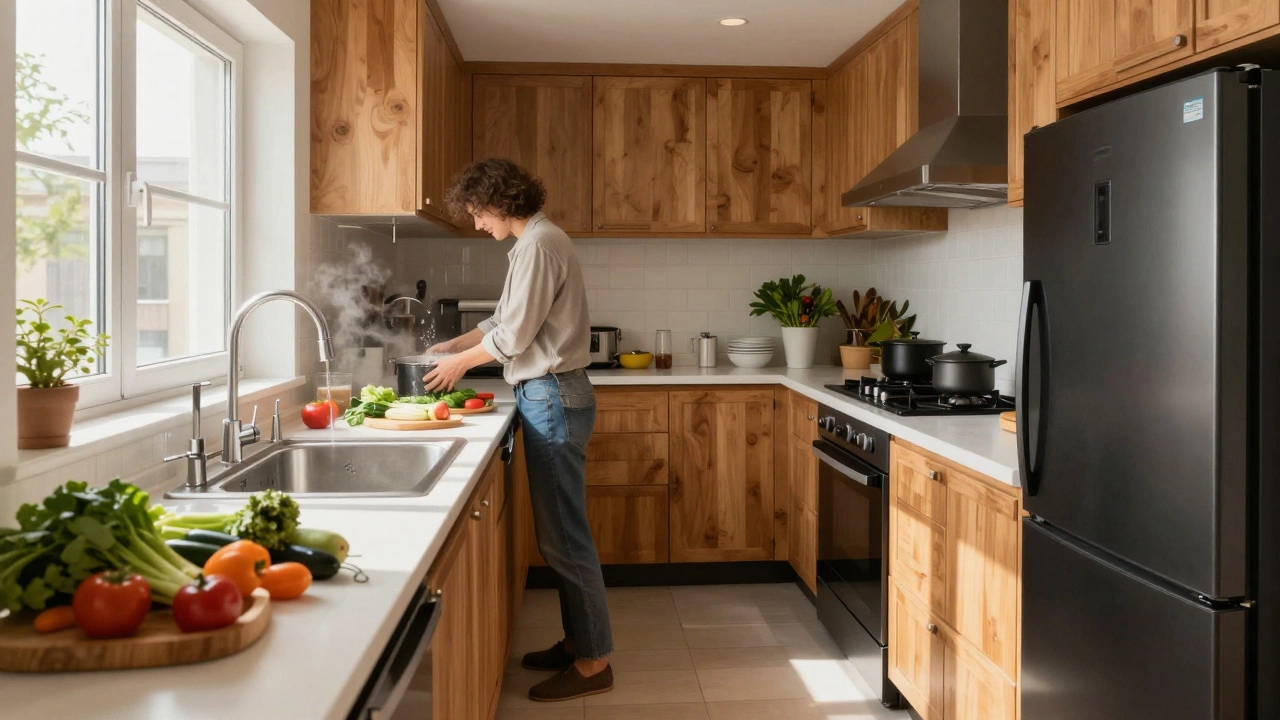
Where you put your stove and sink isn’t just about convenience-it affects how much you enjoy cooking, how safe your kitchen is, and even how much time you waste every week. Too many kitchens look great in magazines but feel like a maze when you’re actually cooking dinner after work. The truth? There’s no single perfect spot, but there are clear rules that work for real life.
Why the Kitchen Triangle Still Matters
The classic kitchen triangle-sink, stove, and refrigerator-isn’t outdated. It’s a proven workflow. You don’t need to follow it rigidly, but ignoring it completely leads to wasted steps. Picture this: you grab veggies from the fridge, walk across the room to wash them at the sink, then backtrack to the stove to cook. That’s 15 extra steps every time you make a simple stir-fry. Over a year, that’s over 1,000 unnecessary paces.
The triangle works because it keeps the three most-used tasks close: prep (sink), cook (stove), and store (fridge). The total distance between all three points should be between 4 and 9 meters. No single leg should be under 1.2 meters or over 2.7 meters. If your sink is too far from the stove, you’re spilling water. If the fridge is too far from the sink, you’re leaving food out too long.
Where to Put the Sink
The sink isn’t just for washing dishes. It’s your cleanup hub. You rinse produce, soak pots, wash hands, and sometimes even prep food. That means it needs to be near the trash, near the fridge (for food prep), and within easy reach of the stove (for rinsing ingredients before cooking).
Best spot? Along an exterior wall, preferably with a window. Why? Natural light makes washing dishes less tedious, and you get fresh air when you open the window. Plus, plumbing runs easier along exterior walls-fewer costly surprises during renovation. If you have a view of the backyard or garden, you’ll enjoy washing dishes more. I’ve seen kitchens where the sink faces a blank wall. People avoid doing dishes. It’s real.
Avoid putting the sink in a corner. It’s hard to reach the back, and you lose usable counter space. If you’re installing a double sink, make sure the main one is closest to the stove. You’ll be rinsing food scraps into it constantly.
Where to Put the Stove
The stove is where the heat is-literally. It needs space, airflow, and safety. Never place it directly across from the sink. Water and gas don’t mix. A spill near the stove can cause burns or fires. Even steam from boiling water can damage controls over time.
Best location? Against an interior wall, away from high-traffic paths. Why? You don’t want someone walking behind you while you’re flipping a steak. A clear 90 cm of space on each side of the stove is ideal. That lets you set down hot pots without knocking things over.
Island stoves are popular, but they’re not for everyone. If you have kids, pets, or narrow walkways, an island stove can be dangerous. If you do go for it, make sure the controls are on the side closest to the wall, not the open side. And always install a powerful range hood directly above it.
Electric stoves? They’re more forgiving with placement. Gas stoves? You need a gas line. If you’re remodeling, check where the line runs. Moving it can cost thousands.
The Ideal Layouts for Real Homes
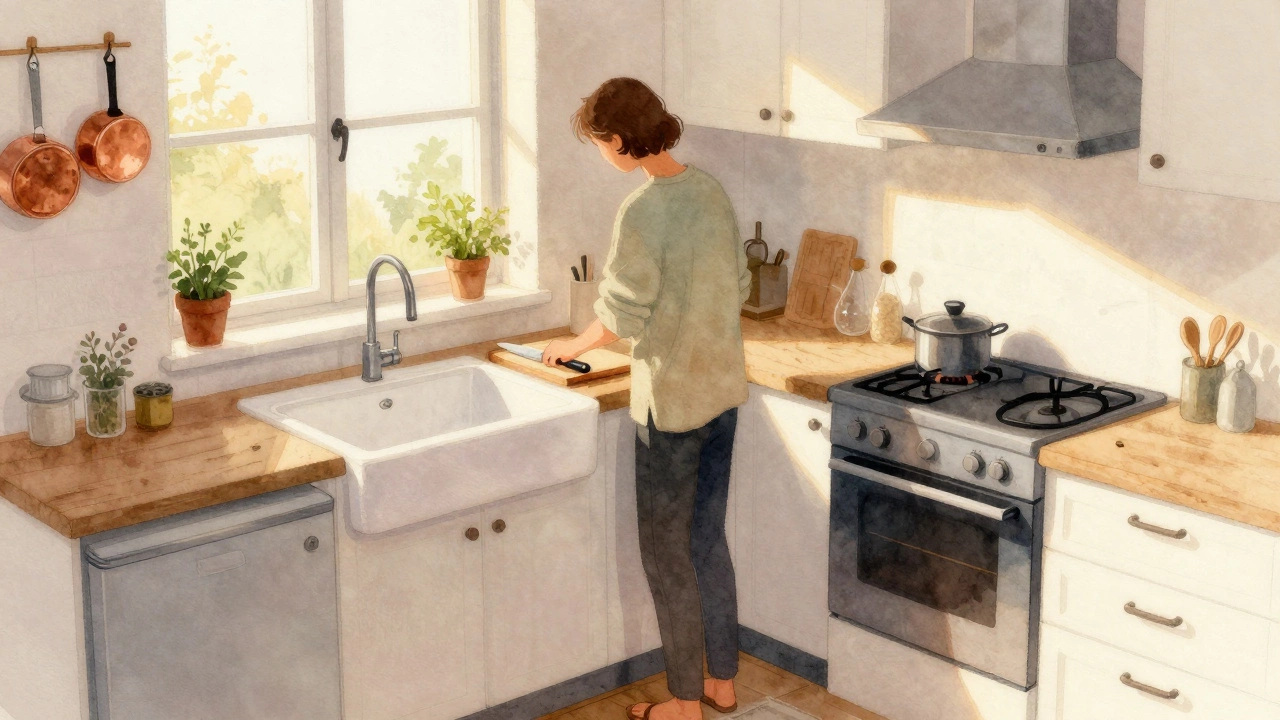
There are three kitchen layouts that work best for most people. Not the fancy L-shapes you see on Instagram. The ones that actually get used.
- Galley Kitchen: Sink on one wall, stove on the opposite. Fridge at one end. Perfect for small spaces. You walk in a straight line-no turning. Keep the sink and stove under 3 meters apart. This layout is efficient but can feel cramped if the hallway is too narrow.
- L-Shaped Kitchen: Sink and stove on adjacent walls. Fridge at the corner. This gives you plenty of counter space and keeps everything close. The most popular layout in Australian homes. Easy to add a breakfast bar or island without blocking flow.
- U-Shaped Kitchen: Sink on one leg, stove on another, fridge on the third. Maximum storage and counter space. Best for serious cooks or large families. But make sure the center is open-no clutter. You should be able to turn around without bumping into cabinets.
Avoid the ‘wrong’ U-shape: sink and stove on the same wall. That creates a bottleneck. You’re constantly crossing paths with someone else. It feels chaotic.
What About the Fridge?
You didn’t ask about the fridge, but it’s part of the triangle. Keep it within 1.5 meters of the sink. That way, you can grab ingredients, rinse them, and go straight to the stove. If your fridge is tucked into a corner or behind a door, you’ll end up carrying groceries halfway across the kitchen. That’s not design-that’s frustration.
Also, avoid placing the fridge next to the stove. Heat from the stove makes the fridge work harder. It uses more power and wears out faster. Leave at least 60 cm between them. If you have to choose between fridge-stove distance and fridge-sink distance, pick fridge-sink. You prep food more often than you cook.
Common Mistakes to Avoid
- Stove under a window: Curtains can catch fire. Wind can blow out a gas flame. If you must, use a solid, non-flammable window treatment and keep it closed while cooking.
- Sink facing the entrance: It looks clean, but it’s awkward. People walk in, see dirty dishes, and feel like they’re intruding. Put the sink where it’s private-facing a wall or a window with a view.
- Too much counter space between sink and stove: You’ll end up setting hot pans on the counter. That’s a burn hazard. Keep prep space tight. 60 cm between sink and stove is enough. More than that, and you’re creating a trip zone.
- Island with no ventilation: If your stove is on an island, you need a hood that pulls air up and out. Recirculating hoods don’t cut it. They just move grease around the kitchen.
Real-Life Example: Melbourne Kitchen
I’ve helped design kitchens in Melbourne for over a decade. One client had a 4m x 3m space with a window on the left wall. They wanted an island. We kept the sink under the window for light and views. The stove went on the opposite wall, 2.1 meters away. The fridge sat at the end of the short wall, just 1.3 meters from the sink. The result? A 10-second path from fridge to sink to stove. They cook every night. They say it’s the only reason they actually enjoy it.
They didn’t need a $20,000 renovation. Just smart placement.
Final Rule: Test It
Before you build or buy, walk through your routine. Pretend you’re making tea: grab the kettle from the cupboard, fill it at the sink, turn on the stove, wait, pour. Time it. Do you trip over a cabinet? Do you stretch too far? If the path feels awkward, change it.
Use painter’s tape to mark the sink, stove, and fridge spots on the floor. Walk the route 10 times. If you’re still thinking about it after the 10th time, you’ve got it right.
Kitchen design isn’t about trends. It’s about rhythm. When the stove and sink are where they should be, cooking stops being a chore. It becomes part of your day-not something you dread.