
Small Bathroom Towel Ring Placement Advisor
Select your bathroom characteristics below to get personalized placement recommendations with exact measurements and installation tips.
Your Bathroom Profile
Ready to Analyze
Configure your bathroom profile and click the button to receive tailored placement recommendations.
You know that feeling when you step out of the shower, grab your towel, and immediately trip over a cluttered counter or knock something off a tiny shelf? It’s frustrating. In a small bathroom, every square inch matters. You can’t just hang things wherever they fit. You have to be strategic. One of the most common mistakes people make is treating towel storage as an afterthought. They pick a fancy towel ring because it looks good in a catalog, then struggle to find a spot for it without blocking the door or creating a tripping hazard.
A towel ring isn't just decor; it's a functional tool. If placed poorly, it becomes useless. The goal is simple: keep your hand towels accessible, dry, and out of the way. Let’s look at exactly where to put that ring so your small bathroom actually works for you.
The "Dead Space" Strategy: Walls You Forgot About
In a cramped bathroom, we tend to focus on the walls next to the sink or the toilet. But those spots are often prime real estate for mirrors, medicine cabinets, or artwork. Instead, look up and look behind. Vertical space is your best friend.
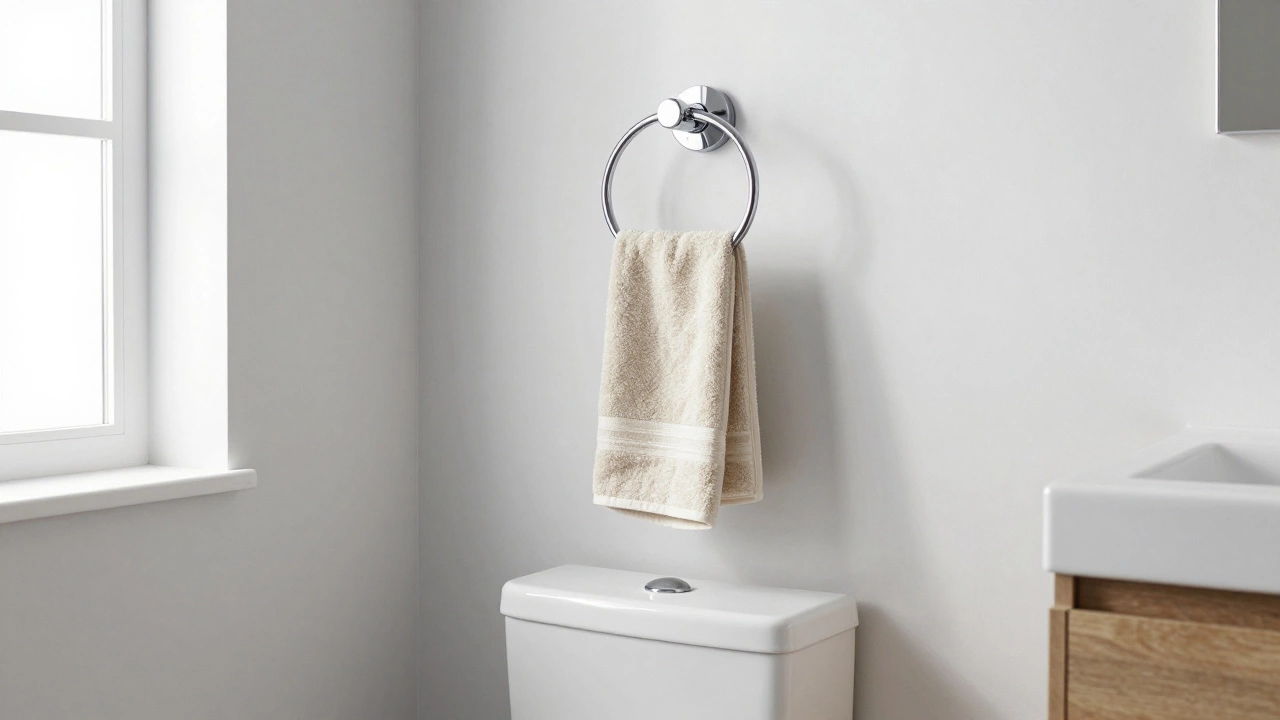
Consider the wall above the toilet. This area, often called the "toilet tank zone," is usually empty. Mounting a towel ring here keeps the towel within reach but clears the floor and counters. Just ensure it’s high enough that you don’t hit your head if you’re leaning forward to wash your hands. A height of about 48 to 50 inches from the floor is standard, but in a small room, you might go slightly higher to maximize visibility.
Another overlooked spot is the side of a vanity cabinet. If your vanity has solid sides (not open shelving), you can mount a ring directly onto the side panel facing into the room. This pulls the towel away from the main traffic flow and keeps it close to the sink without taking up wall space near the mirror.
The Door Hack: Using Hinges and Handles
If your walls are covered in tiles that are hard to drill into, or if you rent and can’t make permanent changes, the bathroom door is a goldmine. Most people ignore the door itself, focusing only on what hangs *off* it.
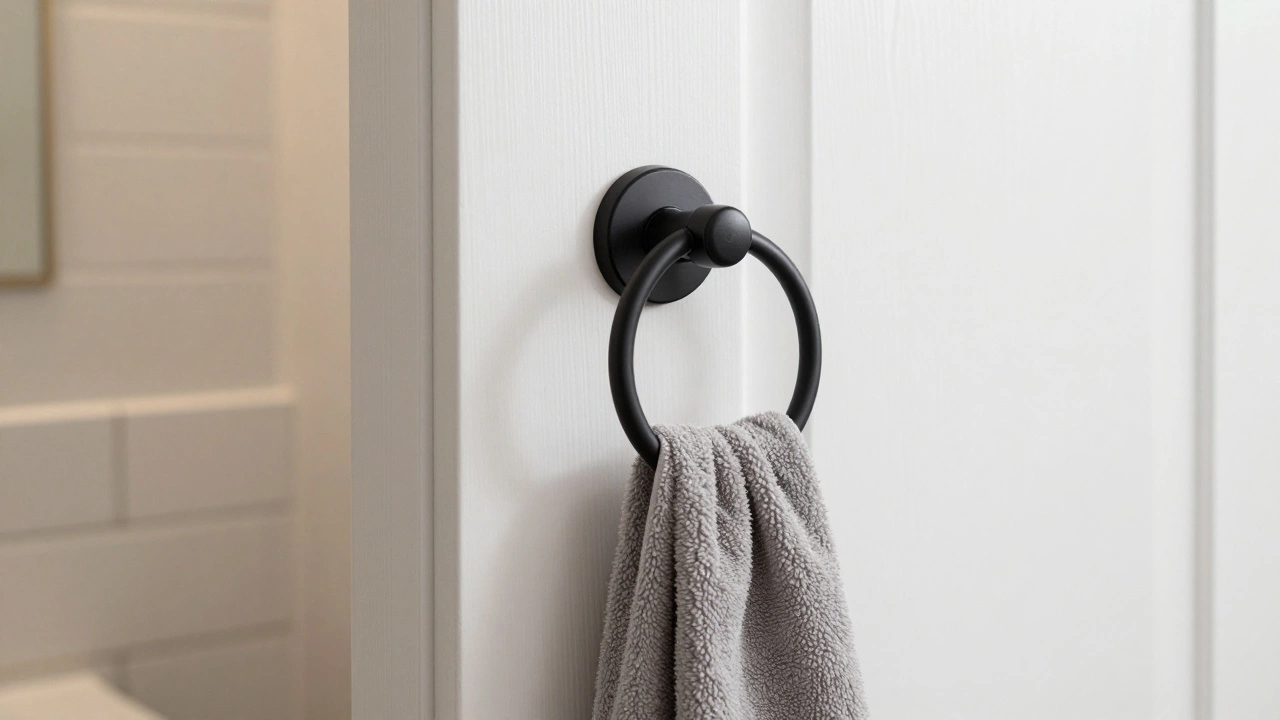
You can install a surface-mount towel ring on the back of the door. This is perfect for guest bathrooms or powder rooms where you want everything to look tidy when the door is closed. When you open the door, the towel is right there. Just measure carefully. Make sure the ring doesn’t interfere with the door handle or the hinges. If your door swings inward, this is even better-it tucks the towel away completely when not in use.
For renters, adhesive-backed towel rings are a viable option here. Look for heavy-duty strips rated for at least 5 pounds. Test them on a small tile first. If the door is hollow-core wood, drilling might weaken it, so stick to adhesives or tension-rod solutions.
Corner Solutions: Reclaiming Awkward Angles
Corners are naturally awkward in small rooms. They collect dust and rarely get used for anything other than storing cleaning supplies. But a corner-mounted towel ring can turn that dead zone into useful storage.
There are specific brackets designed for 90-degree angles. These allow you to mount the ring flush against both walls. This is ideal if you have a small gap between the bathtub and the vanity. By placing the ring in that corner, you avoid protruding into the walkway. Standard rings stick out about 6 to 7 inches, which can be an obstacle in a narrow path. Corner mounts often sit flatter, reducing the intrusion into the room by nearly half.
Just check the plumbing. Sometimes pipes run along corners. Use a stud finder with pipe detection to avoid drilling into water lines. If you find pipes, move the ring higher up, closer to the ceiling line, where pipes are less likely to be present.
Near the Sink: Convenience vs. Clutter
The most logical place for a hand towel is next to the sink. You wash your hands, you dry them. Simple. But in a small bathroom, putting a ring too close to the faucet creates splashes. Water droplets land on the towel, making it damp and musty over time.
The sweet spot is about 12 to 18 inches away from the edge of the sink basin. This distance prevents splash-back while keeping the towel within easy reach. If your sink is small, consider mounting the ring on the adjacent wall rather than the same wall as the faucet. This lateral movement saves vertical space and keeps the visual field around the mirror clean.
Avoid placing the ring directly under a window if that window opens inward. Condensation from showers can accumulate on cold glass, dripping onto the towel below. Moisture is the enemy of towel hygiene. Keep the towel in a well-ventilated spot, ideally near an exhaust fan or a vent.
Over the Tub: A Dual-Purpose Spot
If your small bathroom includes a tub, the wall above it is often bare. While you wouldn’t put a daily hand towel here (it’s too far from the sink), this is a great spot for a bath towel ring or a decorative fold-over hook. However, if you’re strictly using a ring, consider its proximity to the shower curtain.
If the shower curtain swings open and hits the towel ring, the towel will get wet every time you shower. Measure the swing radius of the curtain. If the ring falls within that arc, move it to the opposite wall or higher up. Alternatively, use a tension rod inside the shower to hang a separate robe hook, leaving the exterior wall free for a neatly folded hand towel that stays dry.
| Location | Pros | Cons | Best For |
|---|---|---|---|
| Above Toilet | Uses dead space, clear of traffic | May be too high for some users | Full baths with limited wall space |
| Back of Door | No drilling needed, hides clutter | Can block door if not measured well | Renters, powder rooms |
| Corner Mount | Saves linear wall space | Requires specific hardware | Tight gaps between fixtures |
| Side of Vanity | Close to sink, out of sight | Limited width availability | Vanity-heavy layouts |
| Adjacent Wall | Prevents splash damage | Requires extra walking steps | Small sinks with high splashes |
Material Matters: Why Size Isn't Everything
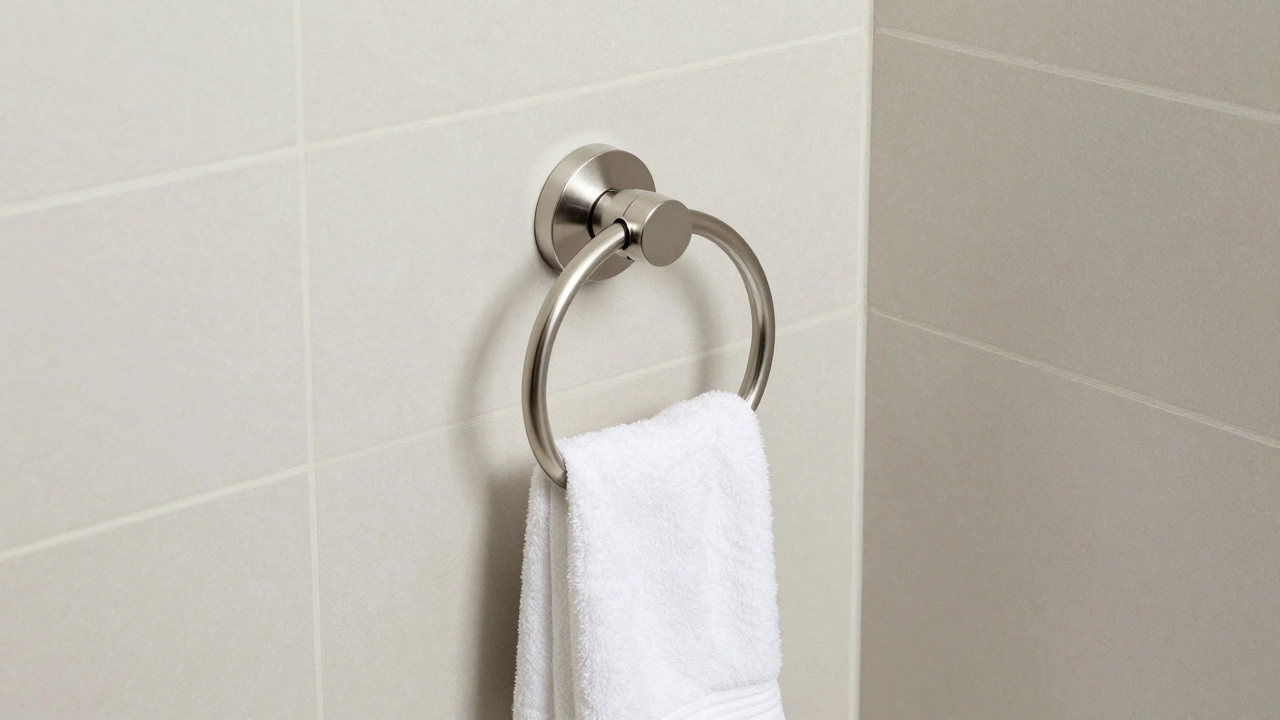
In a small bathroom, the material of your towel ring affects how much space it visually occupies. Chrome and polished nickel reflect light, making the room feel larger. Matte black or oil-rubbed bronze absorbs light, which can make a tiny space feel cozier but also smaller.
If you’re worried about the ring sticking out too far, look for "low-profile" designs. These rings are shallower, meaning the towel folds more compactly. A standard ring holds a towel spread wide; a low-profile one keeps it tighter against the wall. This subtle difference can save you two inches of clearance, which is significant when navigating around a bathtub.
Also, consider the weight. Solid brass rings are durable but heavy. If you’re mounting them on drywall without hitting a stud, you’ll need robust anchors. Plastic or lightweight metal options are easier to install but may wobble if you pull the towel aggressively. For small bathrooms, stability is key-you don’t want the ring pulling away from the wall every time you dry your hands.
Common Mistakes to Avoid
Don’t place the ring too low. Below 36 inches, it becomes a tripping hazard and collects dust from mopping. Don’t place it directly behind a door hinge. The door won’t close fully, leading to frustration and potential damage to the ring. And finally, don’t ignore ventilation. A towel that never dries completely breeds bacteria and mildew. Even in a small bathroom, prioritize airflow over aesthetics.
Measuring twice is crucial. Mark the spot with pencil tape before drilling. Live with the mark for a day. See if it interferes with your routine. Does it block your view in the mirror? Does it catch your elbow when you brush your teeth? Adjust accordingly. Small bathrooms require precision. Get it right, and that towel ring becomes an invisible part of your daily comfort. Get it wrong, and it’s just another obstacle in an already tight space.
How high should a towel ring be installed in a small bathroom?
The standard height for a towel ring is 48 inches from the floor to the center of the ring. In a small bathroom, you can raise this to 50-52 inches to utilize vertical space above toilets or vanities, ensuring it remains reachable but out of the way of daily traffic and cleaning activities.
Can I put a towel ring on the back of the bathroom door?
Yes, mounting a towel ring on the back of the door is an excellent space-saving solution. Ensure the ring does not interfere with the door handle or hinges. Measure the door thickness and choose a ring with adjustable depth if necessary. This is particularly useful for renters who cannot drill into walls.
What is the best type of towel ring for a small bathroom?
Low-profile or shallow-depth towel rings are best for small bathrooms as they minimize protrusion into the room. Materials like chrome or brushed nickel reflect light, enhancing the sense of space. Avoid bulky, ornate designs that add visual clutter and physical obstruction.
Should I use adhesive hooks for towel rings in a rental?
Adhesive hooks can work for lightweight towel rings, but they must be rated for at least 5-10 pounds to hold a damp towel securely. Test the adhesive on a small, hidden area first. For heavier rings or long-term use, consider tension rods or removable mounting kits that don't damage walls.
How do I prevent my hand towel from getting wet from sink splashes?
Mount the towel ring at least 12-18 inches away from the edge of the sink basin. Placing it on the adjacent wall rather than the same wall as the faucet also helps. Ensure the location is outside the direct spray pattern of the faucet to keep the towel dry and hygienic.